About 44 minutes
Laboratory — Themes and Context
Other Worlds
10,083 recorded words. 0 minutes difference from this book's estimate.
View Gutenberg source #59470

The catalog record for The Last Martian — A Closer Reading provides practical reading context through 9,940 words, 44 min estimated reading time, and 1 detected text section.
The text analysis averages about 20.0 words per sentence, while the detected sections provide another way to judge how the source is divided.
Project Gutenberg metadata also associates the work with “Science fiction,” connecting these edition facts with the source record’s subject description.
Explore this collection
These alternatives are selected using recorded categories and estimated reading time.
About 44 minutes
Other Worlds
10,083 recorded words. 0 minutes difference from this book's estimate.
View Gutenberg source #59470About 44 minutes
Other Worlds
10,036 recorded words. 0 minutes difference from this book's estimate.
View Gutenberg source #61371About 42 minutes
Other Worlds
9,617 recorded words. 2 minutes difference from this book's estimate.
View Gutenberg source #51727Search stored excerpts and compare books → Choose by your preferences →
Choices use stored catalog measurements. Estimates vary with reading speed. A shared category is a catalog label, not a claim that two books have the same argument or literary quality.
Search reads excerpt text stored with this catalog and links to its associated Gutenberg record. The connection is stored in the site database; this tool does not recheck that every excerpt is word-for-word identical to that external record. Excerpt search does not cover every chapter and does not verify historical publication dates.
Catalog snapshot checked: 2026-09-25. Coverage: 92 public books, 92 available source excerpts.
Read the complete public-domain text at its original source.
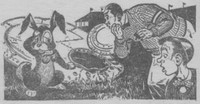
Read on Project GutenbergThe story opens with Peetn, a furry, tentacled Martian, battling a predatory odlat in the dark. His physical details—bellyplates, ear-cupulas, spiny tail—and the sensory world of screaming wind and sub-zero cold establish a vividly alien physiology and environment. The narrative voice is immediate, grounding the reader in Peetn's exhaustion and pain.
When Harrison Clark, a human from Gamtl (Earth), appears, the story shifts to a cross-species encounter. Clark's casual dialogue—calling Peetn "Beany, old boy"—contrasts sharply with the Martian's dignified struggle. The catalog subjects list "Human-alien encounters," and the excerpts show this not as conflict but as a tentative partnership around a shared problem: the failing pumps that sustain Mars.
The excerpts build Peetn's world through physical detail. He has "furry shoulders," "tentacles," a "spiny tail," and "yellow, sac-like eyes." His movement is described as stalking, stilted, and laborious, emphasizing an upright but alien gait. The setting is a dying planet: the sun sinks, the wind throbs, and the cold is penetrating. Peetn's shelter is a hollow where he crawls on his "bellyplates." These specifics ground the story in a tangible, non-human experience.
The odlat attack is visceral: a screech, inch-long teeth, poison. Peetn's weapon—a "hissing blaze of light"—and his use of medicinal roots show a resourceful but precarious existence. The narrative lingers on his recovery, the ache of healing, and the scarcity of supplies. This is not a generic desert; it is a world where every root and every drop of water matters.
The central problem is mechanical: "the great pumps of Mars were slowly stopping." Clark diagnoses them as running dry, with thumping and creaking. His solution is oil, which he hauls in a barrel from his ship. The act of pouring oil into the pump's cup is described with care—"Carefully, lest he spill a drop"—and the result is immediate: "the song of the pumps changed!"
This moment ties the alien encounter to a concrete, industrial task. Clark's dialogue reveals his assessment: "Your civilization has sunk right down to rock bottom." The pumps are ancient Martian technology, and Peetn's ignorance of opening valves wider suggests a loss of technical knowledge. The story thus frames survival as a matter of maintenance, not heroics.
Peetn's internal conflict is clear: he watches Clark "tensely, wondering whether or not to force a halt to this tampering." Yet he trusts the "monster from Gamtl" because Clark seems to know what he is doing. This trust is earned through action, not words. Clark's nickname "Beany" and his casual tone contrast with Peetn's dignity, but the cooperation is genuine.
The excerpts show a reciprocal relationship: Clark leaves for three days, returns with oil, and they pull the barrel together. Peetn uses his tentacles to help. The story avoids easy sentiment; Clark's motivation is hinted at by his reflection on Peetn's loneliness. The partnership is practical, built on the shared goal of keeping the pumps running.
The excerpts end with the pumps' song changing, a hopeful note, but the story's title—"The Last Martian"—and the catalog subject "Martians -- Fiction" suggest a broader arc about extinction. Readers should attend to how the narrative balances Peetn's personal survival with the fate of his species. The oil is a temporary fix; the question of what comes next remains open. The story rewards attention to its sensory details and mechanical logic.
Peetn’s quiet trust with Clark stayed with me long after I finished The Last Martian — that fragile moment when two weary beings decide to believe each other. It reminded me of something I once felt reading Laboratory — Themes and Context, where the spaces between creatures speak louder than any machinery. That ache for connection lingers, gentle and unspoken.
Build a private reading journal entry for this title.