About 26 minutes
Dawningsburgh — Context and Discussion
Other Worlds
5,849 recorded words. 0 minutes difference from this book's estimate.
View Gutenberg source #51663
The Unwilling Professor — Edition Insights can be approached with a clearer sense of reading commitment from its source measurements: 5,818 words, 26 min estimated reading time, and 1 detected text section.
The text analysis averages about 16.9 words per sentence, while the detected sections provide another way to judge how the source is divided.
Project Gutenberg metadata also associates the work with “Science fiction,” connecting these edition facts with the source record’s subject description.
Explore this collection
These alternatives are selected using recorded categories and estimated reading time.
About 26 minutes
Other Worlds
5,849 recorded words. 0 minutes difference from this book's estimate.
View Gutenberg source #51663About 25 minutes
Other Worlds
5,698 recorded words. 1 minutes difference from this book's estimate.
View Gutenberg source #51498About 23 minutes
Other Worlds
5,160 recorded words. 3 minutes difference from this book's estimate.
View Gutenberg source #51258Search stored excerpts and compare books → Choose by your preferences →
Choices use stored catalog measurements. Estimates vary with reading speed. A shared category is a catalog label, not a claim that two books have the same argument or literary quality.
Search reads excerpt text stored with this catalog and links to its associated Gutenberg record. The connection is stored in the site database; this tool does not recheck that every excerpt is word-for-word identical to that external record. Excerpt search does not cover every chapter and does not verify historical publication dates.
Catalog snapshot checked: 2026-09-25. Coverage: 92 public books, 92 available source excerpts.
Read the complete public-domain text at its original source.
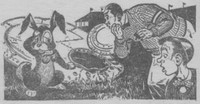
Read on Project GutenbergThe story opens with a precise mathematical metaphor: Fatty Schultz is failing Calculus II "with a velocity that varied directly as the square of the number of lectures attended." This hyperbolic diction immediately establishes a tone of academic absurdity. The Venusian professor, Iglowt P. Slakmak, emerges from a crashed disc that looks like a manhole cover, and his first act is to extend a snowy paw and introduce himself with pompous formality. The contrast between the students' crude slang and the alien's elaborate titles sets up the central comic tension.
Porges builds humor through exaggerated academic language. Irv's math instructor tells him his only salvation lies in "recommencing the study of arithmetic—taking five or ten years in the process—and then retiring to a cave." The instructor's loathing respect and the multiplication-table meditation mock both student incompetence and professorial despair. The fraternity Omega Pi Upsilon, nicknamed "Oh, P-Yu," further undercuts any pretense of scholarly dignity. The narrator's deadpan delivery of these details—such as Fatty heaving rocks at his calculus text—reinforces the story's satirical edge.
Professor Slakmak speaks in a formal, almost bureaucratic register: "Good afternoon, gentlemen. Permit me to introduce myself. I am a good-will ambassador from Venus." His precise diction contrasts with the students' colloquial panic. When he hops toward Fatty, preferring "his larger gravitational field," the scientific jargon applied to a rabbit-like creature creates a comic mismatch. The alien's earnestness—he holds degrees comparable to PhD, LLD, and M—is undercut by his physical absurdity. Porges uses this contrast to lampoon both academic credentialism and the genre's earnest alien-encounter tropes.
The narrative moves from a private clearing to the fraternity house and finally to a brush behind the library. Each setting escalates the stakes: first a crashed ship, then a threatened alien, then a Martian ally who "abhor[s] violence" but bites Irv and Fatty. The Martian Hotspur's cryptic promise to get a "sympathetic hearing in Washington" and his hope that the students "have to take Pasteur treatments" injects a darkly comic note. The story's pacing accelerates through short action beats—lights flashing, yells of agony—before ending on a shared joke about flunking math.
Mathematics is the story's recurring punch line. The opening calculus metaphor, Irv's arithmetic cave, and the final wish that the students "flunk math—but good!" create a thematic thread. Even the alien's ship malfunctions, suggesting a cosmic incompetence. Porges ties every character's motivation to academic failure: the students cut class, the professors despair, and the Venusian ambassador crash-lands. This repetition of failure as a unifying principle gives the story a cohesive satirical target. The closing line, where Slakmak calls Hotspur "Pal," signals a shift from formal address to camaraderie, completing the deflation of alien dignity.
Readers should attend to how Porges uses mathematical language as a comic device rather than a plot element. The story's humor depends on the gap between the alien's formal speech and the students' crude reality. Note also how the author avoids explaining the mechanics of the Venusian or Martian societies; the aliens remain functional stereotypes. The brevity of the tale (under 6,000 words) means every line of dialogue and description carries weight—especially the recurring references to academic failure.
That Venusian professor stuck with me—how quietly it captured the exhaustion of pretending, the absurd way we cling to titles. It reminded me of another story where cleverness becomes its own trap, a gentle spiral of ambition and consequence. That one, License to Steal — Edition Insights, lingers too, in that same half-smiling, unsettled way, like a memory you keep turning over.
A brief reflection can help important ideas stay with you longer.