About 34 minutes
The Lights on Precipice Peak — Context and Discussion
Other Worlds
7,726 recorded words. 0 minutes difference from this book's estimate.
View Gutenberg source #49826
For Half past Alligator — Reading Notes, the stored edition analysis reports 7,755 words, 34 min estimated reading time, and 1 detected text section.
The text analysis averages about 14.2 words per sentence, while the detected sections provide another way to judge how the source is divided.
Project Gutenberg metadata also associates the work with “Science fiction,” connecting these edition facts with the source record’s subject description.
Explore this collection
These alternatives are selected using recorded categories and estimated reading time.
About 34 minutes
Other Worlds
7,726 recorded words. 0 minutes difference from this book's estimate.
View Gutenberg source #49826About 33 minutes
Other Worlds
7,375 recorded words. 1 minutes difference from this book's estimate.
View Gutenberg source #50924About 35 minutes
Other Worlds
8,049 recorded words. 1 minutes difference from this book's estimate.
View Gutenberg source #62078Search stored excerpts and compare books → Choose by your preferences →
Choices use stored catalog measurements. Estimates vary with reading speed. A shared category is a catalog label, not a claim that two books have the same argument or literary quality.
Search reads excerpt text stored with this catalog and links to its associated Gutenberg record. The connection is stored in the site database; this tool does not recheck that every excerpt is word-for-word identical to that external record. Excerpt search does not cover every chapter and does not verify historical publication dates.
Catalog snapshot checked: 2026-09-25. Coverage: 92 public books, 92 available source excerpts.
Read the complete public-domain text at its original source.
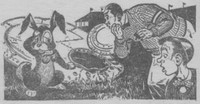
Read on Project GutenbergThe story opens on a baseball diamond, but the field is littered with alien details: Quxas with "flat, piebald faces" crowd the baseline, a five-legged thrag canters across the outfield, and a hole dug by a Quxa goes forgotten. This collision of the familiar and the strange sets the tone for Donald Colvin's 1953 novelette, where the rules of baseball become a framework for exploring cross-species communication and the limits of cultural imposition. The narrative moves between the ball game, the protagonist's romantic disappointment, and the Quxas' rapid adoption of human customs, all within a compact 7,755 words.
The baseball field is not merely a setting but a stage where human and Quxa interactions are choreographed. The opening scene establishes a controlled chaos: Bill Bradley shooes Quxas off the first-base line, they move "in the wrong direction," and a thrag breaks loose. The game proceeds despite these interruptions, with players adapting to alien obstacles. Later, the Quxas themselves form a team, chanting a nonsense cheer that blends human baseball culture with their own linguistic patterns: "Hoe tomata; hoe potata / Half past alligata." The sport becomes a shared language, but one that the Quxas reinterpret through their own logic—they plan to "catch nine new Quxas" to improve their team, treating recruitment as a hunting expedition.
The story traces a visual transformation of the Quxa settlement, mirroring the protagonist's emotional arc. Initially, the camp is described as "straggling, haphazard," with "flimsy huts and untended starvation patches." After the appraisal group's arrival and the baseball holiday, the village is rebuilt: "building sites were laid out in straight, broad rows," fields are plowed, and a wall of brambles is erected. The baseball fields themselves become a central feature, "affectionately tended." This shift from disorder to structured community is echoed in the Quxas' adoption of a sun dial to mark time for work and play. The image of the baseball cap recurs as a symbol of participation—first worn by the Quxa who greets Candy, then by the nine who rescue her from the horals.
Colvin uses physical movement to signal shifts in tone and focus. The story opens on the baseball field, then follows Bill as he "trotted off the mound" and catches sight of Candy, triggering a flashback to Vensor III. Later, Candy's walk through the transformed Quxa town serves as a guided tour for the reader, revealing the changes wrought by baseball. The shuttlebug that brings the appraisal group is a threshold device: it delivers Candy and Vance Montgomery, the catalyst for Bill's despair, and also the athletic equipment that sparks the holiday. The final rescue scene involves a charge by the Quxas, who move from "military formation" to a bobbing bow, then trot down the road—a sequence that blends violence with absurdity.
The Quxas speak in a pidgin that mixes baseball slang with alien syntax. Their leader explains: "Billbrad do it. He tell us how. Work one by one, he say, work all time to fill belly, maybe fill horal belly instead." This voice is consistent across characters, from the captain who says "Misfortunately not" to the laborer who confides, "Yestday I fool Billbrad." The dialogue serves a dual purpose: it conveys the Quxas' rapid learning while maintaining their otherness. Their cheer, with its rhythmic nonsense, is a linguistic artifact that blends human and alien elements. The humans, by contrast, speak in standard mid-century American English, with Bill's internal monologue using metaphors like "gloom enveloped him again, surrounding him like a dank fog."
The story's brevity and focus on a single transformative event—the introduction of baseball—make it a tight, self-contained narrative. Readers should pay attention to how the game functions as both a literal activity and a metaphor for negotiation, competition, and community building. The Quxas' adoption of human customs is never fully explained, leaving room for interpretation about the ethics of such influence. The ending, with its hint of a "culture god" statue, suggests that the consequences of this contact are only beginning.
I recall how Half past Alligator left me pondering the quiet ache of unspoken words, how baseball’s shared field only widened a chasm. That same longing for understanding—and the fear of missteps— lingers in Perfect Answer — Context and Discussion, as if both books were old friends, nodding to each other across my shelf.
Save your reaction, strongest insight, and memorable passage.