About 31 minutes
Rough Beast — Reading Companion
Other Worlds
6,963 recorded words. 0 minutes difference from this book's estimate.
View Gutenberg source #48880

For The Birds of Lorrane — Reading Notes, the stored edition analysis reports 6,916 words, 31 min estimated reading time, and 1 detected text section.
The text analysis averages about 13.6 words per sentence, while the detected sections provide another way to judge how the source is divided.
Project Gutenberg metadata also associates the work with “Science fiction,” connecting these edition facts with the source record’s subject description.
Explore this collection
These alternatives are selected using recorded categories and estimated reading time.
About 31 minutes
Other Worlds
6,963 recorded words. 0 minutes difference from this book's estimate.
View Gutenberg source #48880About 31 minutes
Other Worlds
6,992 recorded words. 0 minutes difference from this book's estimate.
View Gutenberg source #51482About 32 minutes
Other Worlds
7,328 recorded words. 1 minutes difference from this book's estimate.
View Gutenberg source #51478Search stored excerpts and compare books → Choose by your preferences →
Choices use stored catalog measurements. Estimates vary with reading speed. A shared category is a catalog label, not a claim that two books have the same argument or literary quality.
Search reads excerpt text stored with this catalog and links to its associated Gutenberg record. The connection is stored in the site database; this tool does not recheck that every excerpt is word-for-word identical to that external record. Excerpt search does not cover every chapter and does not verify historical publication dates.
Catalog snapshot checked: 2026-09-25. Coverage: 92 public books, 92 available source excerpts.
Read the complete public-domain text at its original source.
Read on Project GutenbergIngomar Bjorgson walks into the desert to die, leaving his bubble house door open so the sand can erase his presence. The opening paragraphs establish a stark, fatalistic tone: the universe is 'eager to be rid of him.' Yet the story quickly subverts this bleakness. The intelligent birds, Pisces I and Pisces II, are not the noble saviors Ingomar hoped for. They are manipulative, bickering, and self-serving. The narrative tension arises from the gap between Ingomar's expectations and the birds' actual behavior—a pattern of deception that unfolds with dark humor.
The setting is a planet that is 'one hundred per cent desert,' where the wind and sun conspire to obliterate all traces of human presence. Ingomar watches sand drift into his footprints, and the bubble house's reflection becomes a 'tiny bright spot' in the vastness. This imagery of erasure mirrors his psychological state: he feels his life and death will leave no permanent mark. The environment is not merely a backdrop but an active agent, complicit in his planned demise. The story's opening emphasizes the physical toll—burned skin, stumbling, removal of clothes—as Ingomar strips down to bare feet, leaving a trail of discarded garments. The desert is indifferent, but the birds' subsequent intervention reveals that even in this barren place, intelligence can be duplicitous.
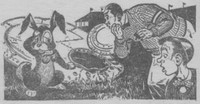
The birds, described as having 'minds like the edge of a razor,' are not what they seem. They claim to have summoned a rescue ship, but in truth they have been using Ingomar's ship for parts. Their dialogue is laced with petty squabbling: 'Shut up!' and 'Hold your tongue.' They admit their deception with a sheepish 'Despicable,' yet they show no genuine remorse. The rescue ship they produce is round and dull white, 'like a giant egg,' a visual pun that underscores their avian nature. The birds' motivation is pragmatic: they need a faster ship to continue their own search for intelligent life. This inversion—where the seekers of intelligence are themselves the deceivers—creates a wry commentary on the nature of contact.
After Ingomar collapses, the birds apply a mysterious ointment that 'penetrated deep down, under the burned skin, into flesh and muscle, soothing injured cells.' The healing is rapid and almost magical, allowing Ingomar to recover quickly. Yet the birds are impatient: 'We've got to take you to ... what do you call it, Earth? ... We're in sort of a hurry to get home.' Their urgency contrasts with Ingomar's earlier resignation. The final twist comes when Ingomar asks why they were so far from home: they were looking for intelligent life. The story ends with Pisces I's irritable remark that if they don't waste time on Earth, they 'may still find some.' This punchline reframes the entire narrative as a cosmic joke—the intelligent life they sought was right in front of them, but they were too busy deceiving him to notice.
The Birds of Lorrane uses a simple premise—a man stranded with intelligent birds—to explore themes of trust, survival, and the irony of the search for extraterrestrial intelligence. The desert setting amplifies the stakes, while the birds' bickering and deceit add a layer of dark comedy. Readers should pay attention to the subtle shifts in power: Ingomar begins as the doomed explorer but ends as a passenger on a ship piloted by his former captors. The story rewards attention to small details, such as the birds' ship design and their casual admission of a century-long partnership.
I remember finishing The Birds of Lorrane and thinking how gullible I was, rooting for those birds. It stirred up a long-ago afternoon lost in Doorstep, where trust felt just as fragile and the silence of a room held its own quiet betrayal. That echo lingered, a reminder that deception often wears the gentlest feathers. Doorstep — Themes and Context brought that same unease back, softly.
Answer a few questions and save a private reflection on this device.