About 31 minutes
The Birds of Lorrane — Reading Notes
Other Worlds
6,916 recorded words. 0 minutes difference from this book's estimate.
View Gutenberg source #50890
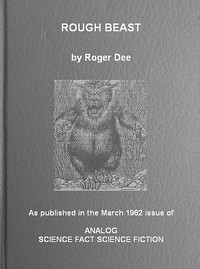
The catalog record for Rough Beast — Reading Companion provides practical reading context through 6,963 words, 31 min estimated reading time, and 2 detected text sections.
The text analysis averages about 18.3 words per sentence, while the detected sections provide another way to judge how the source is divided.
Project Gutenberg metadata also associates the work with “Science fiction,” connecting these edition facts with the source record’s subject description.
Explore this collection
These alternatives are selected using recorded categories and estimated reading time.
About 31 minutes
Other Worlds
6,916 recorded words. 0 minutes difference from this book's estimate.
View Gutenberg source #50890About 31 minutes
Other Worlds
6,992 recorded words. 0 minutes difference from this book's estimate.
View Gutenberg source #51482About 32 minutes
Other Worlds
7,328 recorded words. 1 minutes difference from this book's estimate.
View Gutenberg source #51478Search stored excerpts and compare books → Choose by your preferences →
Choices use stored catalog measurements. Estimates vary with reading speed. A shared category is a catalog label, not a claim that two books have the same argument or literary quality.
Search reads excerpt text stored with this catalog and links to its associated Gutenberg record. The connection is stored in the site database; this tool does not recheck that every excerpt is word-for-word identical to that external record. Excerpt search does not cover every chapter and does not verify historical publication dates.
Catalog snapshot checked: 2026-09-25. Coverage: 92 public books, 92 available source excerpts.
Read the complete public-domain text at its original source.
Read on Project GutenbergThe story opens with the Morid, a vicious alien predator, crash-landing in the Florida Keys after escaping from a Galactic Federation ship. The narrative immediately establishes a dual perspective: the Morid's predatory instincts and the human operators of a Telethink station, who sense the creature through their telepathic equipment. The setting—a moonlit mangrove island—becomes a stage for a hunt that hinges on a critical misjudgment of size.
The story alternates between the Morid's alien consciousness and the human characters' reactions, creating tension through contrasting viewpoints. The Morid is described with animalistic terms like "harried wolf" and "juggernaut," emphasizing its raw ferocity. Meanwhile, the humans—Vann, Ellis, and the hermit Charlie Trask—are portrayed through their mundane activities, such as grading shrimp or drinking homebrew, which heightens the contrast when danger arrives. This structural choice underscores the theme of miscommunication across species.
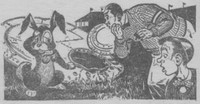
The Morid is consistently framed as a predator: it senses "life and therefore food," and its "joy of killing" is noted. However, the story subverts this expectation when the creature is killed by a domestic cat, Max. The revelation that the Galactic beings are tiny—their ship measures only twenty-two feet—recasts the entire conflict. The humans, by contrast, are "Brobdingnagians in a universe of Lilliputians," a reference that inverts the power dynamic. This shift from fear to ironic superiority is a key structural pivot.
The Telethink technology serves as both plot mechanism and thematic tool. It allows the Galactic ship to monitor the Morid's thoughts, but the "barbarous" signals are incomprehensible to them. For the humans, the Telethink transmits the Morid's "aura" with "empathetic horror," causing one operator to faint. This telepathic link creates a shared experience of terror, yet it also highlights the failure of communication: the Galactics cannot interpret human signals, and the humans initially misunderstand the threat's scale. The device thus bridges and separates the two species.
The story is firmly rooted in a specific geographical setting: the Florida Keys, with references to Dutchman's Key, the Oversea Highway, and mangrove vegetation. This locale is not merely backdrop but integral to the plot. The isolated islands and dense brush provide cover for the Morid, while the Telethink station's coastal position allows for the arrival of the alien craft. The hermit Charlie Trask's shack, with its homebrew and cat, represents a mundane human world that ultimately defeats the extraterrestrial threat. The setting thus grounds the science fiction premise in a recognizable, earthy reality.
The story's resolution—a housecat killing a fearsome alien—is both comic and thought-provoking. Readers may consider how the narrative uses scale to critique assumptions about intelligence and power. The final lines, quoting Yeats's "rough beast," invite reflection on humanity's place in a larger universe. This editorial note encourages attention to the story's structural contrasts and its wry commentary on perception.
Reading Rough Beast — Reading Companion, I kept circling back to that quiet misunderstanding of scale, the human horror against the Galactic’s calm. It reminded me, somehow, of the gentler disorientations aboard the Kali, where proximity itself becomes the story. There’s a particular ache in both, I think. Captain of the Kali — Context and Discussion still sits with me for that same reason.
Capture what you thought, learned, and would like to remember.