About 44 minutes
Captain of the Kali — Context and Discussion
Other Worlds
10,036 recorded words. 0 minutes difference from this book's estimate.
View Gutenberg source #61371

The source record for Laboratory — Themes and Context measures this digital text at 10,083 words, 44 min estimated reading time, and 2 detected text sections.
The text analysis averages about 14.7 words per sentence, while the detected sections provide another way to judge how the source is divided.
Project Gutenberg metadata also associates the work with “Science fiction,” connecting these edition facts with the source record’s subject description.
Explore this collection
These alternatives are selected using recorded categories and estimated reading time.
About 44 minutes
Other Worlds
10,036 recorded words. 0 minutes difference from this book's estimate.
View Gutenberg source #61371About 44 minutes
Other Worlds
9,940 recorded words. 0 minutes difference from this book's estimate.
View Gutenberg source #62097About 42 minutes
Other Worlds
9,617 recorded words. 2 minutes difference from this book's estimate.
View Gutenberg source #51727Search stored excerpts and compare books → Choose by your preferences →
Choices use stored catalog measurements. Estimates vary with reading speed. A shared category is a catalog label, not a claim that two books have the same argument or literary quality.
Search reads excerpt text stored with this catalog and links to its associated Gutenberg record. The connection is stored in the site database; this tool does not recheck that every excerpt is word-for-word identical to that external record. Excerpt search does not cover every chapter and does not verify historical publication dates.
Catalog snapshot checked: 2026-09-25. Coverage: 92 public books, 92 available source excerpts.
Read the complete public-domain text at its original source.
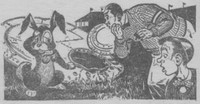
Read on Project GutenbergJerome Bixby's 'Laboratory' opens with a distinctly non-human perspective: the bluish-purple tint of Gop's apologetic thoughts and Pud's irritable thought-snapping. The story immediately establishes a hierarchical relationship between the Senior Scientist Pud and his Junior Gop, with Pud's multiple heads and eyes scattered across his body like 'gurf-seeds on rolls'. The Vegans are not merely alien in appearance but in cognition—their thoughts have colors, their swearing is 'atheistic', and their technology includes fields that shape reality itself. The central tension is established early: the Vegans must keep their laboratory invisible from the human astronauts landing on their planet, a task complicated by Gop's negligence and Pud's temper.
The story's humor derives from the gap between the Vegans' immense power and their inability to control their own creations. Pud has been shaping a 'thig-field' for three weeks, only to squelch it when the humans arrive. A 'yim-field' that took 'laborious psycho-induction' is dismissed with a thought. These invisible experiments are not just background—they drive the plot. When the humans land, the fields interact unpredictably: a force-field bounces into another, converting water to alcohol and instantly intoxicating the astronauts. The Vegans' technology is so advanced that even their mistakes produce spectacular effects, yet they are reduced to frantically deactivating experiments and herding beasts through an intraspatial doorway.
Pud and Gop are not single-minded beings. Pud has 'more than a hundred eyes' set in 'various-sized heads', and Gop's 'seventh head' is mentioned as something that can be shown or hidden. This physical multiplicity mirrors their mental conflicts: Pud is a 'totalitantrum' waiting to happen, while Gop is a 'Transverse Colon Revivalist' offended by Pud's swearing. Their dialogue is peppered with exclamations like 'Chew!' and 'dripping mouthfuls', suggesting a culture with its own idioms. The story uses their multiple perspectives to create comedy—Pud's eyes glower upward while others scour the planet—and to emphasize the difficulty of coordinating a hidden laboratory when even one's own body parts can betray the secret.
The climax involves a menagerie of alien beasts that escape through a reversed intraspatial doorway. These creatures are described in vivid, absurd terms: a 'ten-ton gopher', a beast 'resembling a steam-shovel on spider's legs'. They are invisible until they stumble into view, and their behavior is chaotic—they chase, fight, and trample through the laboratory. The Vegans' attempts to control them are slapstick: Gop hardens his tentacles to 'pig iron' and hurls a beast through the doorway 'like a projectile'. The doorway itself is a one-way portal that can be reversed, a simple but effective device that creates a cascade of trouble. The humans, Johnny and Helen Gorman, are passive observers, drunk and bewildered, while the Vegans struggle to restore order.
Readers should pay attention to the way Bixby uses sensory details—the 'whine-and-crackle' of fields, the 'gargantuan roar' of an invisible Pud—to make the invisible visible. The story rewards attention to the Vegans' internal conflicts, which are as important as the external chaos. The incomplete excerpts leave open questions about the fate of the humans and the laboratory, but the pattern of escalating mishaps suggests that the Vegans' attempt to avoid Contact will fail spectacularly.
I’ve always found a quiet kinship between Bixby’s scientists and the lone Martian observer—both bound by solitude, one comic, one aching, yet both quietly desperate to be understood by those who cannot see their world. The Last Martian — A Closer Reading feels like a whispered answer to that frantic, invisible chaos. Funny how we shelve them together.
Save your reaction, strongest insight, and memorable passage.