About 47 minutes
Star-Crossed Lover — Reading Notes
Other Worlds
10,672 recorded words. 0 minutes difference from this book's estimate.
View Gutenberg source #51736
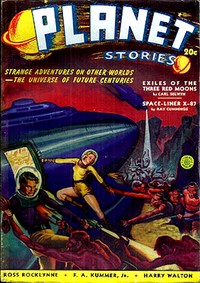
Star Pirate — A Closer Reading can be approached with a clearer sense of reading commitment from its source measurements: 10,799 words, 47 min estimated reading time, and 2 detected text sections.
The text analysis averages about 14.2 words per sentence, while the detected sections provide another way to judge how the source is divided.
Project Gutenberg metadata also associates the work with “Science fiction,” connecting these edition facts with the source record’s subject description.
Explore this collection
These alternatives are selected using recorded categories and estimated reading time.
About 47 minutes
Other Worlds
10,672 recorded words. 0 minutes difference from this book's estimate.
View Gutenberg source #51736About 46 minutes
Other Worlds
10,400 recorded words. 1 minutes difference from this book's estimate.
View Gutenberg source #60809About 46 minutes
Other Worlds
10,468 recorded words. 1 minutes difference from this book's estimate.
View Gutenberg source #62168Search stored excerpts and compare books → Choose by your preferences →
Choices use stored catalog measurements. Estimates vary with reading speed. A shared category is a catalog label, not a claim that two books have the same argument or literary quality.
Search reads excerpt text stored with this catalog and links to its associated Gutenberg record. The connection is stored in the site database; this tool does not recheck that every excerpt is word-for-word identical to that external record. Excerpt search does not cover every chapter and does not verify historical publication dates.
Catalog snapshot checked: 2026-09-25. Coverage: 92 public books, 92 available source excerpts.
Read the complete public-domain text at its original source.
Read on Project GutenbergThe story begins not with a space battle but with a young man staring out a window on Ceres, remembering the cold. The narrator, Stephen, has lived on the asteroid for fifteen years and recalls Earth only as "a series of dream-like impressions." His uncle John has dismissed the miners after the palladium vein ran out, leaving Stephen alone with a flame gun and a safe full of gray ingots. The opening pages establish a mood of lonely anticipation rather than action, with the threat arriving not from the void but from a sleek silver space-ship settling onto the plain.
The central revelation in the excerpts is that Stephen's father, Vance McClean, is not dead but alive—and he is the "star pirate" of the title. He arrives with a young woman named Clare Conroy, daughter of a man he was accused of murdering. The confrontation in the office shifts the story from a simple heist to a tangled history of partnership, flight, and a hidden diary. Vance claims that Uncle John framed him for the murder and then stole control of Cerean Mining. The diary, found in the safe, is presented as proof of John's guilt. The excerpts do not show the diary's contents, but the accusation is laid out in dialogue: John supposedly killed Conroy, let Vance take the blame, and then hushed up the investigation to avoid scrutiny. The scene relies on verbal confrontation rather than physical action, with Vance enjoying his upper hand while a Jovian named Taon physically restrains John.
The palladium in the safe is the story's MacGuffin, but the excerpts treat it with unusual specificity. The narrator notes that the ingots are worth "nearly a million dollars' worth in earth currency" and that the safe is "triply-reinforced." The theft is already in progress when Uncle John arrives: the safe door has been blasted open. Yet the dialogue quickly moves past the metal to focus on the diary and the murder accusation. The catalog subject "Robbery -- Fiction" is accurate, but the excerpts suggest that robbery is a pretext for a deeper conflict about inheritance and justice. The setting on Ceres, a dwarf planet, is described in terms of its "thin, dustless atmosphere" and "light gravity," but these details are used to explain why escape would be difficult rather than to create a sense of wonder. The story's world-building is functional, serving the plot rather than the other way around.
The narrative voice is first-person, past tense, with a reflective tone that occasionally breaks into direct address: "It was cold that night, I remember." The prose is efficient, with short paragraphs and dialogue that carries the exposition. The excerpts show a preference for scene-based storytelling: the opening vigil, the arrival of the ship, the confrontation in the office. There is no indication of a larger space-opera backdrop; the action is confined to the mining compound. The catalog subject "Fathers and sons -- Fiction" is borne out by the central relationship, but the excerpts show the father and son meeting as adults, with Vance treating Stephen almost as an afterthought. The story's title, "Star Pirate," is ironic: Vance is a pirate only in the sense that he has been outlawed, not because he commands a ship or raids commerce. The excerpts suggest a story more concerned with family secrets than with interstellar adventure.
Readers should note that the excerpts cover only the first half of the story, ending before the diary's contents are revealed or the conflict is resolved. The narrative relies heavily on dialogue and confrontation, and the resolution may hinge on the diary's evidence. The setting on Ceres is used for its isolation, not for exotic detail, and the science fiction elements are minimal. Those expecting a swashbuckling space adventure may find a family drama instead.
That old tale of the nephew on Ceres always made me think of family secrets locked away like palladium. So much hinges on trust and what a stolen diary reveals. It shares a quiet kinship with License to Steal — Edition Insights, another study of taking what is not freely given. Both whisper about the weight of possession, and the loneliness it brings.
Save your reaction, strongest insight, and memorable passage.