About 75 minutes
The Soul Eaters — Reading Notes
Space Future
17,247 recorded words. 1 minutes difference from this book's estimate.
View Gutenberg source #63150
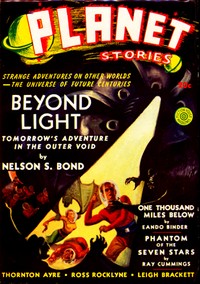
Before opening Phantom of the Seven Stars — Context and Discussion, the edition data offers a quick orientation: 17,369 words, 1 hr 16 min estimated reading time, and 2 detected text sections.
The text analysis averages about 13.1 words per sentence, while the detected sections provide another way to judge how the source is divided.
Project Gutenberg metadata also associates the work with “Science fiction,” connecting these edition facts with the source record’s subject description.
Explore this collection
These alternatives are selected using recorded categories and estimated reading time.
About 75 minutes
Space Future
17,247 recorded words. 1 minutes difference from this book's estimate.
View Gutenberg source #63150About 78 minutes
Space Future
17,721 recorded words. 2 minutes difference from this book's estimate.
View Gutenberg source #50999About 88 minutes
Space Future
20,215 recorded words. 12 minutes difference from this book's estimate.
View Gutenberg source #62137Search stored excerpts and compare books → Choose by your preferences →
Choices use stored catalog measurements. Estimates vary with reading speed. A shared category is a catalog label, not a claim that two books have the same argument or literary quality.
Search reads excerpt text stored with this catalog and links to its associated Gutenberg record. The connection is stored in the site database; this tool does not recheck that every excerpt is word-for-word identical to that external record. Excerpt search does not cover every chapter and does not verify historical publication dates.
Catalog snapshot checked: 2026-09-25. Coverage: 92 public books, 92 available source excerpts.
Read the complete public-domain text at its original source.
Read on Project GutenbergRay Cummings opens Phantom of the Seven Stars with a first-person narrator who immediately establishes his dual role: IP agent Jim Fanning is assigned to watch a passenger, Brenda Carson. The prose is brisk and sensory, describing Brenda's appearance with precise details—"pale-gold hair" with "mingled starlight and earthlight"—that ground the space setting in tangible imagery. Cummings uses the narrator's observations to blend duty with attraction, a common pulp device, but the clipped sentences and immediate focus on the girl's "pert, oval little face" signal a direct, no-nonsense style.
Cummings's diction is economical, favoring short declarative sentences that drive the action. Phrases like "That much, at least, wasn't hard" and "I must explain that I was—and still am—an IP Man" create a conversational, almost breathless tone. The narrator's asides—"Certainly, she was an inspiring figure to any young man"—blend reportage with personal reaction, a hallmark of pulp first-person. Cummings avoids ornate language; even descriptions of space are functional: "Mars, our destination, hanging like a great dull-red ball." This choice keeps the focus on plot momentum rather than atmosphere.
Dialogue in the excerpts reveals character through brevity and subtext. Brenda's murmured question—"Asteroid-9? Is that what it's called?"—carries a "startled glance" and "terror," suggesting hidden knowledge. Her brother Philip's quick interjection—"Rotten sort of place, by what I've heard"—dismisses the topic, showing his protective role. Cummings uses dialogue to advance suspicion: Brenda's later line, "I was going to escape from the ship then," delivered with a "twisted little smile," hints at duplicity. The exchanges are terse, with characters often speaking in fragments, mirroring the tension of the setting.
Cummings builds the asteroid Asteroid-9 through concrete, scientific-sounding details: "five-hundred miles in diameter, amazingly dense," with "chemicals in the cloud-vapors" poisoning water. The description is clinical—"base metals, of no particular value"—yet the narrator's casual tone makes it feel like common knowledge. Later, the asteroid's "leaden sky" and "broken rock-spires" create a desolate backdrop. Cummings avoids romanticizing space; instead, he emphasizes the practical dangers: no food, no water, and a "bleak, barren little globe." This choice grounds the fantastical pirate plot in a harsh, believable environment.
The narrative structure relies on short paragraphs and rapid scene shifts. Cummings moves from the ship's interior to the asteroid surface with minimal transition, using line breaks to indicate time jumps. The pacing accelerates during action: "Abruptly she was gripping me. 'Look—Jim—look there!'" The discovery of the Seven Stars on the asteroid is handled in a single paragraph, with the narrator's realization—"That's the Seven Stars!"—delivered as a gasp. Cummings also uses repetition for emphasis: "We stared, mute, transfixed, watching." This technique heightens suspense without lengthy exposition.
Cummings's authorial choices—direct diction, dialogue that hints at hidden motives, and a setting described with scientific precision—create a fast-paced space adventure that prioritizes plot over introspection. Readers should note how the narrator's voice, at once confiding and urgent, shapes the story's tension. The excerpts suggest a work that rewards attention to small details, such as the significance of the asteroid's gravity or the characters' offhand remarks.
Reading about Jim Fanning’s clipped voice aboard the Seven Stars brought back the old deck chair where I first met the stubborn captain in The Upside-Down Captain — Edition Insights. That same feeling of a small, hard world holding its breath. Both stories felt like whispers into the dark, asking only for patience.
Answer a few questions and save a private reflection on this device.