About 312 minutes
Alien Minds — Edition Insights
Space Future
71,625 recorded words. 137 minutes difference from this book's estimate.
View Gutenberg source #50863
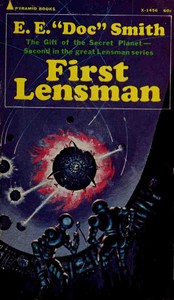
For First Lensman — Edition Insights, the stored edition analysis reports 103,137 words, 7 hr 29 min estimated reading time, and 9 detected text sections.
The text analysis averages about 14.4 words per sentence, while the detected sections provide another way to judge how the source is divided.
Project Gutenberg metadata also associates the work with “Science fiction,” connecting these edition facts with the source record’s subject description.
Explore this collection
These alternatives are selected using recorded categories and estimated reading time.
About 312 minutes
Space Future
71,625 recorded words. 137 minutes difference from this book's estimate.
View Gutenberg source #50863About 262 minutes
Space Future
60,142 recorded words. 187 minutes difference from this book's estimate.
View Gutenberg source #43235About 92 minutes
Space Future
21,120 recorded words. 357 minutes difference from this book's estimate.
View Gutenberg source #61845Search stored excerpts and compare books → Choose by your preferences →
Choices use stored catalog measurements. Estimates vary with reading speed. A shared category is a catalog label, not a claim that two books have the same argument or literary quality.
Search reads excerpt text stored with this catalog and links to its associated Gutenberg record. The connection is stored in the site database; this tool does not recheck that every excerpt is word-for-word identical to that external record. Excerpt search does not cover every chapter and does not verify historical publication dates.
Catalog snapshot checked: 2026-09-25. Coverage: 92 public books, 92 available source excerpts.
Read the complete public-domain text at its original source.
Read on Project GutenbergThe novel opens with a startling image: an assassin fires seven bullets into a scientist at close range, yet the victim turns calmly and says, “I have been expecting you.” This moment establishes a pattern of physical threat rendered futile by superior mental power. The scene is set in “The Hill,” a laboratory crowded with workers who notice nothing—a detail that underscores the hidden war between Arisian and Eddorian entities. Smith immediately introduces a conflict fought not with ships alone, but with minds that can deflect projectiles and perceive events across interstellar distances.
The narrative alternates between high-level strategic meetings and hands-on reconnaissance. A key sequence follows three Lensmen as they track a mysterious signal to the planet A-Zabriskae Two. The journey is methodical: they calculate periodicity, position their scout, and wait. The planet itself is described as “small, waterless, airless, utterly featureless”—a deliberate contrast to the rich mental landscapes of the Lensmen. Smith uses the barren setting to heighten the puzzle: a relay station buried in featureless sand, emitting a signal that seems to come from nowhere. The structure here is one of patient investigation, with each piece of data narrowing the field until the team lands on a world that “never will be” inhabited.
Smith repeatedly emphasizes extreme physical conditions. On A-Zabriskae Two, the ground temperature is “four hundred seventy-five degrees,” the sun is “ultra-fervent blue-white,” and the surface is “blindingly reflective, fiendishly hot white sand.” Yet the space-suits are “very well insulated, particularly as to the feet.” These details ground the fantastic in tangible discomfort. Earlier, the assassin’s bullets are described as “not ordinary projectiles” that “should have volatilized that form of flesh.” The contrast between the invulnerable body of Bergenholm and the hostile environment of the planet creates a consistent motif: the physical world is dangerous, but the mind—or the Lens—transcends it.
The story shifts abruptly from the enclosed laboratory of The Hill to the open vacuum of space and the featureless desert of a dead world. In the laboratory, the action is intimate: a visitor steps “within six feet” of a scientist. On the planet, the horizon seems “much more distant” because there is nothing to break the line. Smith uses these shifts to emphasize the scope of the conflict. The same characters who discuss the fate of civilization in one chapter are soon crouching on a sand-blasted rock, measuring signals. The movement is not just geographic but perceptual: the reader moves from a space where bullets are meaningless to one where every yard of surface is identical, forcing reliance on instruments and mental discipline.
Smith’s dialogue is clipped and functional, often carrying exposition. When Samms says, “This arouses my curiosity no end—does it merely complicate the thionite problem, or does it set up an entirely new problem?” the line does double duty: it advances the plot and reveals the character’s analytical mind. Technical terms like “bolometer,” “visibeams,” and “spotting screens” are used without explanation, assuming a reader familiar with the genre. The narration itself is precise: “Jack had already determined that the planet they wanted was the second out; A-Zabriskae Two.” This voice treats space travel as a matter of routine calculation, even when the setting is alien and hostile.
Readers should attend to the way Smith builds tension through procedural detail rather than action. The most dramatic moments—an assassination, a planetary landing—are rendered with the same matter-of-fact tone as a technical report. This consistency of voice creates a world where the extraordinary is treated as routine, and where the true drama lies in the slow accumulation of evidence. The excerpts suggest that the novel rewards patience and attention to the small, precise observations that its characters make.
I finished First Lensman feeling the strange weight of small actions echoing across vast distances—that quiet tension in a relay station on a dead world. It reminded me of another story, Tony and the Beetles — Context and Discussion, where perspective shifts so gently you almost miss the moment everything changes. That lingering unease stays with you, like a half-remembered whisper.
Capture what you thought, learned, and would like to remember.