About 36 minutes
A City Near Centaurus — Reading Notes
Machines Invention
8,104 recorded words. 1 minutes difference from this book's estimate.
View Gutenberg source #50802
The catalog record for Not a Creature Was Stirring — Key Ideas to Explore provides practical reading context through 8,336 words, 37 min estimated reading time, and 1 detected text section.
The text analysis averages about 16.4 words per sentence, while the detected sections provide another way to judge how the source is divided.
Project Gutenberg metadata also associates the work with “Science fiction,” connecting these edition facts with the source record’s subject description.
Explore this collection
These alternatives are selected using recorded categories and estimated reading time.
About 36 minutes
Machines Invention
8,104 recorded words. 1 minutes difference from this book's estimate.
View Gutenberg source #50802About 38 minutes
Machines Invention
8,639 recorded words. 1 minutes difference from this book's estimate.
View Gutenberg source #60922About 35 minutes
Machines Invention
7,835 recorded words. 2 minutes difference from this book's estimate.
View Gutenberg source #60624Search stored excerpts and compare books → Choose by your preferences →
Choices use stored catalog measurements. Estimates vary with reading speed. A shared category is a catalog label, not a claim that two books have the same argument or literary quality.
Search reads excerpt text stored with this catalog and links to its associated Gutenberg record. The connection is stored in the site database; this tool does not recheck that every excerpt is word-for-word identical to that external record. Excerpt search does not cover every chapter and does not verify historical publication dates.
Catalog snapshot checked: 2026-09-25. Coverage: 92 public books, 92 available source excerpts.
Read the complete public-domain text at its original source.
Read on Project GutenbergThe story opens with Tom Gannett climbing out of his mine, The Lousy Disappointment, into a sky that is not blue but a dirty purplish-gray, the sun looking “sicker’n a dog.” Evans establishes Gannett’s voice immediately—growling, sardonic, grounded in physical sensation: he sneezes, blows his nose, sniffs the air like a dog. The prose shifts between blunt dialogue and a narrator who catalogues what Gannett does not know, listing three specific ignorances about mankind’s annihilation. This structural device—a list of unknowns—frames the entire story as a discovery process, with the reader tracking Gannett’s slow, reluctant comprehension through what he sees, smells, and touches.
The story’s structure hinges on vertical movement: Gannett climbs up from his mine, descends into Reno’s casinos, and later looks down from a hotel window onto purple snow. Each transition marks a shift in his awareness. Underground, he is insulated; above ground, he confronts a world that smells like an old graveyard. The mine shaft itself becomes a recurring image—a literal hole in the ground that may have protected him from whatever killed everyone else. Evans reinforces this by having Gannett wonder if a “very light gas” could not seep below the surface. The story never confirms this theory, leaving the mechanism of annihilation ambiguous, but the vertical axis remains the primary way Gannett navigates his changed environment.
Evans builds the post-apocalyptic atmosphere through three repeated sensory motifs. Purple dominates: the sky is purplish-gray, snow falls as “big wet, colored things like fluffy bits of cotton candy,” and even the water from a faucet carries a purplish tint. Cold is constant—Gannett’s forehead sweats despite the cold, and the purple snow gives his cheeks “wet, cold caresses.” Silence manifests in frozen tableaux: a cop dead while tying his shoe, a doctor with his hand on a car door, two well-dressed women staring into nothing in a hotel lobby. These static figures contrast with Gannett’s own movement, emphasizing his aloneness. The story does not explain the purple color or the mechanism of death; it simply presents them as sensory facts that Gannett must navigate.
Tom Gannett speaks in a rough, colloquial register—“Hey, you old sun!” and “Aw, for cripe sakes!”—that sets him apart from the more formal narrative voice. The narrator occasionally adopts an ironic, almost clinical tone, as when listing what Gannett does not know in three numbered points. This distance creates a tension between Gannett’s limited perspective and the reader’s broader understanding. Yet the story never fully abandons Gannett’s point of view; his confusion is the reader’s confusion. When he finds a restaurant with coffeemakers still glowing and a Pepsi Cola for breakfast, the details are mundane but charged with loss. The narrative does not moralize or explain; it simply follows Gannett as he pieces together fragments of a world that ended while he was underground.
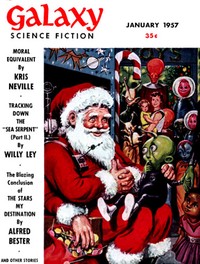
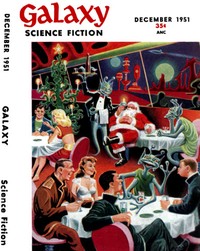
The story opens with a curious note: “This could be a Christmas story. If it is, it shows one way peace on Earth can be attained!” This framing device is never directly referenced again in the excerpts. It hangs over the narrative as an ironic counterpoint to the purple snow and dead bodies. Gannett thinks of Reno at Christmastime, with its cocktail lounges and blondes, but the Christmas he encounters is one of silence and decay. The story does not develop the Christmas theme beyond this initial tease; it remains a structural gesture, a promise the text does not fulfill within the available excerpts. Readers may find the ending—not present here—either subverts or completes this frame, but the excerpts leave it dangling as an unanswered question.
Readers should attend to how Evans uses Gannett’s sensory experience—what he smells, sees, and touches—as the primary vehicle for world-building. The story withholds explanations, forcing the reader to inhabit Gannett’s confusion. Pay particular attention to the recurring image of the mine shaft and the vertical movements between underground and surface; these structure the narrative’s pacing and Gannett’s growing awareness. The Christmas frame, mentioned only at the start, may reward re-examination after the story’s conclusion.
I kept thinking about that strange purple snow, and how Tom’s world shrank to what he could smell and feel. It reminded me of another quiet story, where time itself felt like a borrowed coat. Two Whole Glorious Weeks — Themes and Context lingers on a similar warmth—the ache of a season you know you cannot keep, held gently, the way you hold a last sip of coffee.
Use these questions to collect your thoughts before moving on.