
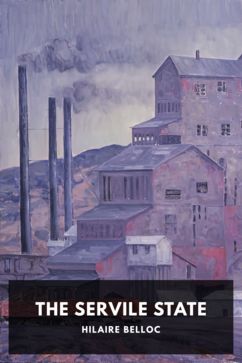
The Servile State - Hilaire Belloc
Forget dry economics. Hilaire Belloc's The Servile State reads like a detective story about our society's future, written in 1912. He starts with a simple, powerful idea: the capitalist system of his time was doomed. It was too unstable, creating deep insecurity for both workers and owners. Belloc believed this wouldn't lead to socialism, as many hoped, but to something much older and more rigid.
The Story
Belloc traces a path from the medieval world of property-owning peasants and craftsmen, through the chaos of the Industrial Revolution. He sees capitalism not as a stable end-point, but as a temporary, messy phase. His core argument is that society, seeking stability, will drift toward a 'Servile State.' In this new-old system, the majority of people (the non-owners) would lose their political and economic freedom. They wouldn't just be employees; they'd be legally compelled to work for a small, propertied class in exchange for basic security. The state would enforce this arrangement, making it permanent. The book is his case for why this was the most likely outcome, not a free society or a socialist utopia.
Why You Should Read It
What grabs me isn't that Belloc was necessarily 'right,' but how his lens makes you think. Reading him today is a shock. When he talks about laws being shaped to protect capital over people, or a populace drowning in debt and dependent on a wage, you'll hear echoes of modern debates about student loans, platform labor, and welfare. He forces you to question what true economic freedom looks like. Is it just the freedom to choose your boss? Or is it something deeper, tied to owning a stake in the world? His writing is blunt, confident, and often unsettling. It cuts through a lot of noise.
Final Verdict
This book is perfect for anyone feeling uneasy about our economic direction, whether you're a politics junkie, a history buff, or just a curious reader. It's short (under 200 pages) and written with fiery clarity. You don't need a degree to get it. Read it not as a prophecy, but as a powerful tool for thought. It will challenge your assumptions about progress and make you look at the structure of our daily lives in a completely new way. A century-old book that still feels urgently relevant.
This publication is available for unrestricted use. Knowledge should be free and accessible.
Thomas Gonzalez
1 year agoI particularly value the technical accuracy maintained throughout.
Oliver Flores
1 year agoI have to admit, the arguments are well-supported by credible references. Thanks for sharing this review.
Aiden Allen
9 months agoRecommended.



Donald Martinez
6 months agoI took detailed notes while reading through the chapters and the practical checklists included are a great touch for real-world use. An excellent example of how quality digital books should be formatted.