
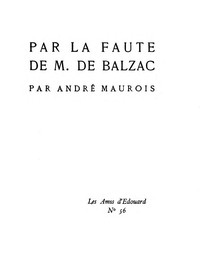
Par la faute de M. de Balzac by André Maurois
The Story
So here’s what happens. Our young hero, bless his foolish heart, has decided he wants to live like a character from Honoré de Balzac’s novels. Not just appreciate the books, mind you — he wants to be a protagonist in his own real-life drama. So he cooks up an elaborate scheme. He meets a charming young widow, pretends he’s from an old noble family, spins wild tales, and basically constructs a whole lover’s identity out of nothing but pages from Balzac’s major works. He writes letters full of lies. He tells her stories about made-up ancestors. It’s all very theatrical. At the same time, he’s also tangled up with a different woman who is very much the practical, common-sense type. And you just know, you just know, that a house of cards made of fine phrases is going to come crashing down. When the truth starts poking through the pretty fabric, it gets not only awkward but plain devastating. The ending? Let’s just say Vélye learns that real emotions don’t follow invented plots.
Why You Should Read It
I picked this up thinking it would be a nice, light period-piece love story, and it kind of was — but it also punched me right in the gut. It’s really about something we all do to some level: falling in love with a story we tell ourselves about someone other than who they really are. Balzac is just the fun framing device. Underneath, Maurois is cheekily pointing out that fake it ’til you become it works much better in books than in life. Plus, the writing is pure delight — it glides like silk. There are these one-line observations about love, lies, and self-deception that feel fresh 100 years after they were written. I also loved how the book quietly begs the question: who has the right to borrow another person's story for their own life? It’s sneaky smart without sounding like a textbook at all.
Final Verdict
Book lovers who secretly fashion themselves as the hero of their own favorite novels? Get the tissues ready. But on a serious note, this is perfect for anyone interested in French literature, lovers of short romantic novels with an edge, and readers who appreciate a good character study disguised as a silly elopement. If you love Donna Tartt’s 'The Secret History' but wish it were shorter, French, and free of most of the murders — this is weirdly your match. And definitely avoid if you hate unhappy (but true-to-feeling) endings. It’s not bitter — but Balzac’s ghost won by knockout.
This masterpiece is free from copyright limitations. Knowledge should be free and accessible.
Nancy Martin
1 month agoAs someone working in this industry, I found the insights very accurate.
David Thompson
3 months agoHaving read the author's previous works, the case studies and practical examples provided add immense value. I'm glad I chose this over the other alternatives.

David Miller
1 year agoI took detailed notes while reading through the chapters and the objective evaluation of the pros and cons is very refreshing. I'm genuinely impressed by the quality of this digital edition.