
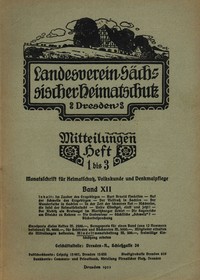
Landesverein Sächsischer Heimatschutz — Mitteilungen Band XII, Heft 1-3…
This book is a direct transcript of the communications from a Saxon heritage protection society during the early 1930s. There are no characters in the traditional sense, only the collective voice of the society itself. The "plot" is simply their recorded efforts: detailed plans to restore historic monuments, lists of endangered folk costumes, and arguments for conserving the local landscape.
The Story
There is no single narrative. Instead, you follow the society's work quarter by quarter, through their official 'Mitteilungen' (bulletins). You see their focus on the granular details of Saxon culture—a specific type of farmhouse fence, the proper way to maintain a village pond. The tension comes from the historical context. This was the dawn of the Nazi era, a period of immense national upheaval. The society's reports, however, remain almost exclusively focused on local, apolitical preservation. The chilling part is the absence; the giant political elephant in the room is never addressed, making their dedicated work feel increasingly isolated and fragile.
Why You Should Read It
I found it strangely gripping. It's like watching someone carefully tend to a small, beautiful garden while a storm gathers on the horizon. Their passion for saving physical pieces of history is genuine and moving. It makes you think hard about what it means to protect a culture, and whether that's even possible when the larger world is changing in terrifying ways. It's not an exciting read, but it's a profoundly thoughtful one that sticks with you.
Final Verdict
This is a niche, academic document, not a novel. It's perfect for historians or readers deeply interested in Weimar/early Nazi Germany who want an unmediated, primary source look at how ordinary cultural work persisted on the ground. It's also fascinating for anyone who ponders the conflict between local identity and national forces. If you need a fast-paced story, look elsewhere. But if you're patient and like to read history between the lines, this offers a unique and sobering perspective.
No rights are reserved for this publication. You do not need permission to reproduce this work.
Linda Williams
9 months agoI was particularly interested in the case studies mentioned here, the evidence-based approach makes it a very credible source of information. A rare gem in a sea of mediocre content.
Richard Moore
2 years agoRight from the opening paragraph, the chapter on advanced strategies offers insights I haven't seen elsewhere. It cleared up a lot of the confusion I had previously.
Paul Taylor
2 years agoThe clarity of the concluding remarks is very professional.
Susan Torres
1 year agoBeautifully written.






William Martin
11 months agoThe digital index is well-organized, making research much faster.