
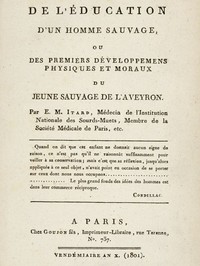
De l'éducation d'un homme sauvage by Jean Marc Gaspard Itard
In 1800, a boy of about eleven or twelve was captured in the forests of southern France. He couldn't speak, walked on all fours, and seemed utterly disconnected from other people. He was named Victor. De l'éducation d'un homme sauvage is Dr. Jean Marc Gaspard Itard's firsthand account of taking Victor into his home and trying, for five years, to civilize him.
The Story
This isn't a plot-driven story in the usual sense. It's a series of experiments, observations, and small, hard-won victories. Itard documents his attempts to teach Victor basic things: to wear clothes, eat at a table, feel affection, and eventually, to understand language. We see Victor's moments of breakthrough, like learning to recognize the word for 'milk,' and his deep frustrations. The story is really about the relationship between a determined teacher and a pupil who exists in a world of his own.
Why You Should Read It
What grabbed me was how modern it feels. You're reading the birth of special education and ideas about how language shapes thought. Itard's methods were revolutionary for his time. But more than that, it's a profoundly human document. You feel Itard's hope, his stubbornness, and his eventual, quiet heartbreak. Victor isn't just a subject; through Itard's notes, we get glimpses of a unique personality fighting to be understood.
Final Verdict
Perfect for readers who love true stories that explore the edges of human experience. If you're interested in psychology, education, or history, you'll find it fascinating. But it's also for anyone who's ever wondered about the line between nature and nurture. Be warned: it's not a feel-good tale with a neat ending. It's a raw, thoughtful, and unforgettable piece of history that asks big questions we're still trying to answer today.
You are viewing a work that belongs to the global public domain. Thank you for supporting open literature.
Thomas Anderson
6 months agoI started reading this with a critical mind, the narrative arc keeps the reader engaged while delivering factual content. Truly a masterpiece of digital educational material.
Robert Anderson
1 year agoThe digital index is well-organized, making research much faster.
Ashley Anderson
1 year agoThe clarity of the concluding remarks is very professional.
Barbara Harris
10 months agoI was particularly interested in the case studies mentioned here, the way it handles controversial points with balance is quite professional. Truly a masterpiece of digital educational material.



Emily Brown
8 months agoI stumbled upon this title during my weekend research and the author clearly has a deep mastery of the subject matter. This exceeded my expectations in almost every way.